
Cloud sovereignty is becoming a critical foundation for modern digital transformation, ensuring that organizations maintain full control over their data, access, and compliance. As AI adoption accelerates and regulations tighten, companies are shifting toward secure, sovereign cloud architectures that balance innovation with governance. This new approach enables businesses to scale confidently while protecting their most …


Cloud Sovereignty: From Regulation to Competitive Advantage
The second wave of digital transformation is no longer centered solely on cloud adoption it is increasingly shaped by cloud sovereignty. For organizations, the challenge is no longer just moving to the cloud but understanding where data resides, who can access it and how it is governed.
According to Microsoft’s 2025 EMEA research:
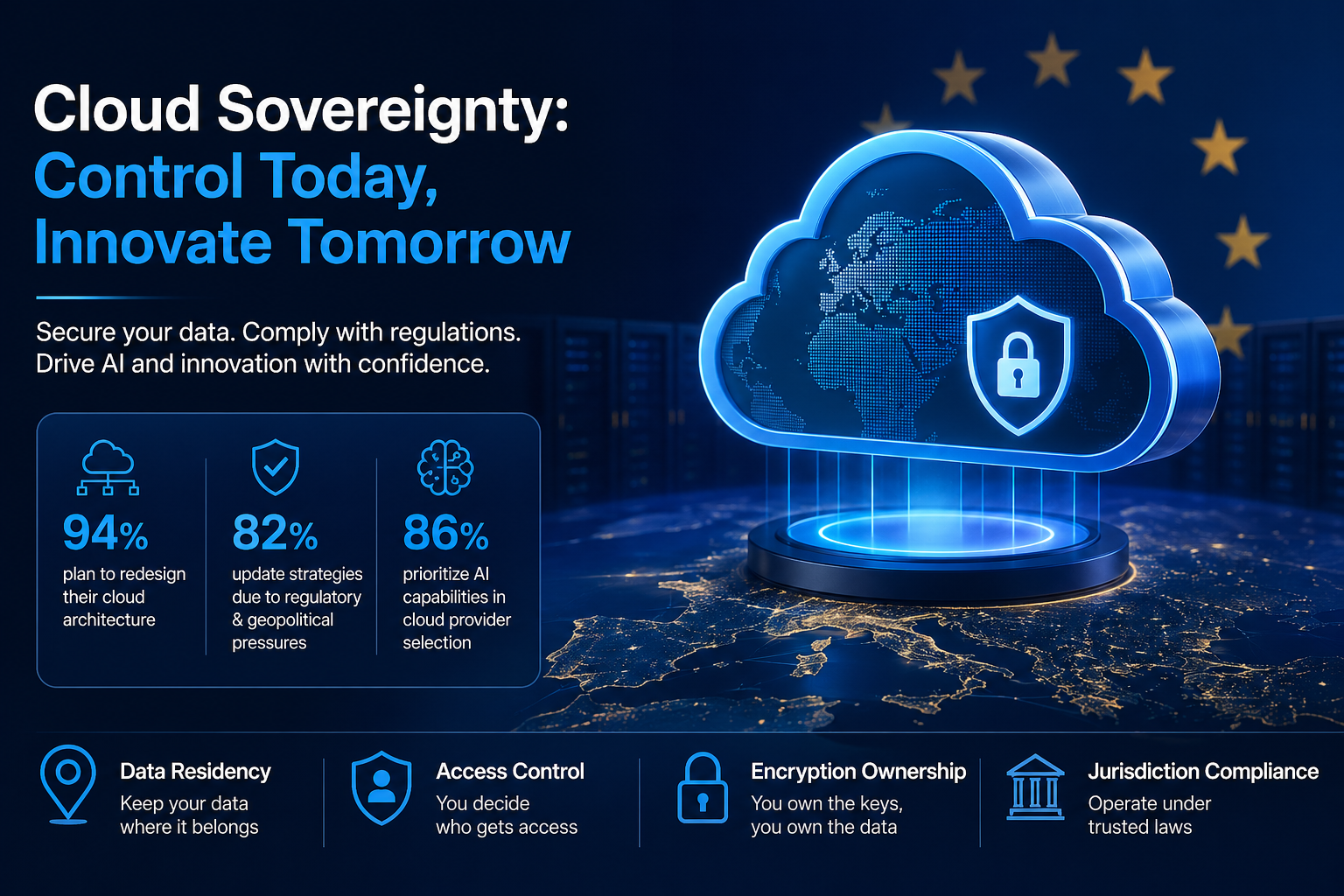
- 94% of organizations plan to redesign their cloud architecture
- 82% are updating their cloud strategies due to regulatory and geopolitical pressures
- 86% consider AI capabilities a critical factor when selecting a cloud provider
These metrics clearly indicate that cloud sovereignty is no longer just a technical concern it is a strategic imperative.
What is Cloud Sovereignty?
Cloud sovereignty, as a subset of digital sovereignty, encompasses multiple layers:
- Data residency (where data is stored)
- Access control (who can access the data)
- Encryption ownership (who controls encryption keys)
- Jurisdictional compliance (legal authority over data)
According to the Azure Sovereignty framework, a system can only be considered truly sovereign if it meets four core criteria:
- Data must be stored only in authorized regions
- Access to data must require customer approval
- Sensitive data must always remain encrypted
- Encryption keys must be fully controlled by the customer
This approach goes beyond the traditional shared responsibility model, introducing a new paradigm:
“Customer-Controlled Cloud”
Why Now?
1. Regulatory Explosion
- Frameworks such as NIS2, DORA and SecNumCloud
- Country-specific data localization requirements
- Sectoral compliance (finance, healthcare, public sector)
2. AI and Data Dependency
Modern AI systems require:
- High-volume data
- Low latency
- Strong security
This inherently makes sovereignty a necessity.
3. Geopolitical Risks
- Cross-border data jurisdiction conflicts
- Supply chain vulnerabilities
- Expanding cyber threat surfaces
Cloud Sovereignty as an Innovation Enabler
Traditional view:
“Sovereignty = constraint”
New reality:
“Sovereignty = controlled innovation”
Examples:
- A municipality achieved 300+ hours/year in operational savings using AI
- AI adoption in banking can deliver up to 15 percentage-point efficiency gains
- In France, 46% of organizations adopt sovereign cloud to enable AI
These figures demonstrate that sovereignty is no longer just about compliance it is a foundation for AI enablement.
Modern Cloud Models: The “Best of Both Worlds”
The next-generation architecture includes:
1. Sovereign Public Cloud
- Local data control + hyperscaler capabilities
- Most widely adopted model (37% adoption rate)
2. Sovereign Private Cloud
- Maximum control
- Higher cost, limited scalability
3. National Partner Cloud
- Locally operated solutions (e.g., Bleu in France, Delos in Germany)
In practice: Hybrid Sovereign Architecture dominates.
Technical Architecture: The Sovereign Cloud Stack
A modern sovereign cloud architecture consists of four layers:
1. Infrastructure Layer
- Region-restricted deployment
- Availability zones and geographic boundaries
2. Security Layer
- Zero Trust Architecture
- Confidential Computing
- Customer-managed encryption keys
3. Governance Layer
- Policy-as-Code (e.g., Azure Policy)
- Audit logs and SIEM integration
4. Access Layer
- Just-in-Time (JIT) access
- Customer Lockbox
- Identity segmentation
In Azure environments, particularly:
- Zero Standing Access (ZSA)
- Just Enough Access (JEA)
are used to significantly minimize operator risk.
The New Normal : Sovereignty by Design
Cloud evolution is moving through three stages:
- Migration
- Optimization
- Sovereignty
At the final stage, success depends on:
- Owning your data
- Controlling access
- Ensuring regulatory compliance
- Enabling innovation simultaneously
This leads to a new paradigm:
“Sovereignty by Design”
Security and sovereignty are no longer add-ons they are embedded into the architecture from the ground up.
D Tech Cloud your trusted technology partner!