
The unauthorized use of AI tools by employees is creating a threat surface that most security programs are not designed to see, let alone manage


A New Kind of Invisible Risk
In 2023, a Samsung engineer pasted proprietary source code into ChatGPT to help debug a problem. The code and everything that could be inferred from it became part of the training data for a commercial AI system operated by a third party. Samsung had no visibility into what was shared, no policy that the engineer had consciously violated and no mechanism to detect or prevent what happened.
This was not a sophisticated attack. It was not a malicious insider. It was an employee trying to do their job more efficiently, using the best tool available to them without any awareness that what they were doing carried significant risk.
This story has become emblematic of a broader phenomenon that security leaders are now grappling with across every industry: Shadow AI and it represents one of the most structurally difficult security challenges of the current decade because the behavior driving it is not just understandable. It is rational.
Employees who use AI tools are, in most cases, more productive. They produce better work faster. They solve problems that previously required expert assistance. The organizational pressure to adopt AI is enormous and employees who find ways to use it authorized or not are often rewarded for the outcomes, regardless of the method.
This creates a security environment where the threat is not coming from outside the organization or even from disgruntled employees with malicious intent. It is coming from highly motivated, high-performing employees doing exactly what they are implicitly encouraged to do.
Defending against this requires a fundamentally different approach than traditional security thinking provides.
Defining the Shadow AI Threat Surface
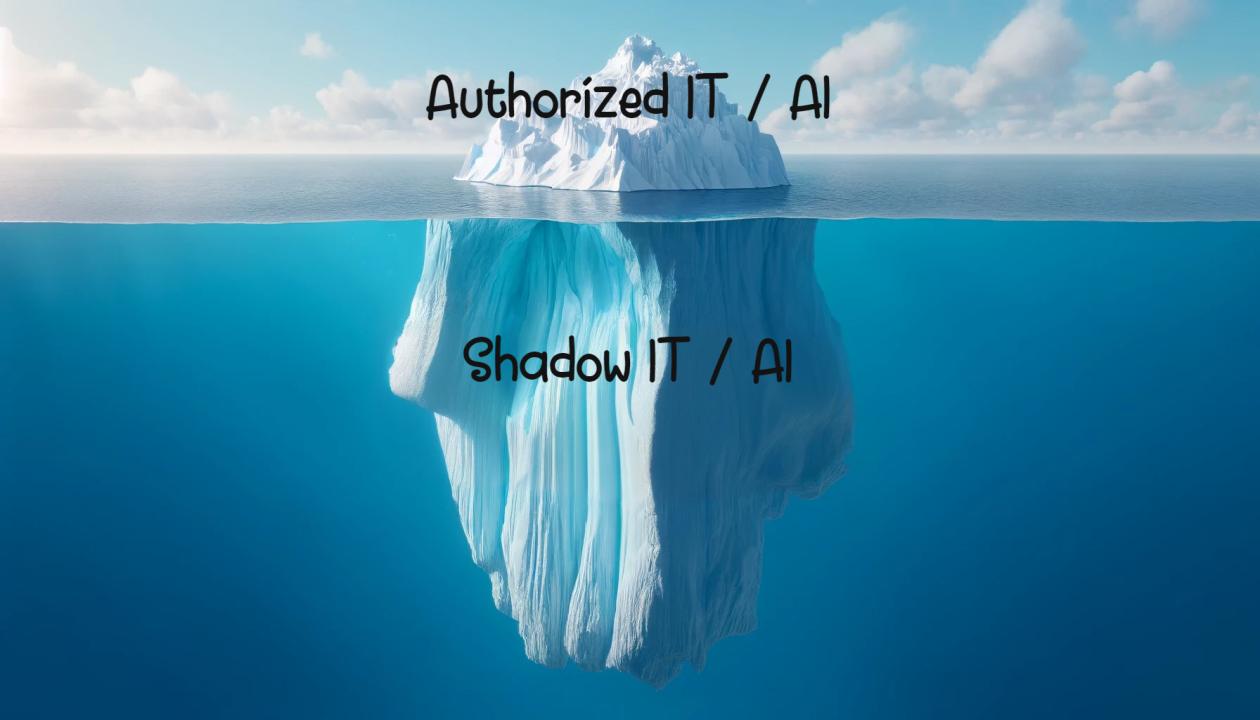
Shadow AI refers to the use of artificial intelligence tools large language models, AI-assisted coding platforms, image generators, document summarizers, AI-powered productivity applications without explicit organizational authorization or governance.
It is the enterprise equivalent of Shadow IT, the phenomenon where employees adopt unauthorized cloud services and applications to circumvent slow or inadequate official tooling. Shadow IT emerged in the early cloud era and took most organizations years to understand and manage. Shadow AI is moving faster, the tools are more capable and the data exposure risks are categorically more severe.
The threat surface Shadow AI creates operates across several dimensions.
Data exfiltration through AI prompts
When an employee pastes a sensitive document into an external AI tool to have it summarized, translated or analyzed, that content leaves the organizational boundary. Depending on the AI provider’s data retention and training policies, that content may be stored indefinitely, reviewed by humans or incorporated into model training.
The employee has, functionally, exfiltrated sensitive data not to a competitor or a malicious actor but to a third-party AI system with it’s own data governance policies that may be entirely incompatible with the organization’s confidentiality obligations, regulatory requirements or contractual commitments.
Sensitive data in AI-generated outputs
AI tools trained on broad internet data can sometimes surface information that was inadvertently included in their training sets. When employees use external AI tools, they may receive outputs that include information about competitors, partners or even their own organization that has leaked into publicly available training data.
More significantly, when employees share proprietary data with AI systems, those systems may later surface fragments of that data to other users potentially including competitors through outputs that appear to be the AI’s own general knowledge.
Third-party AI integration risks
Beyond direct prompt-based interactions, many employees are connecting AI tools directly to organizational systems email accounts, calendar systems, document repositories, CRM platforms through OAuth integrations and third-party application connections. These integrations grant AI tools persistent access to organizational data that extends far beyond any single prompt.
An employee who connects an AI productivity tool to their corporate email account may have granted that tool read access to years of organizational communications, including sensitive negotiations, strategic planning discussions and confidential personnel matters.
AI-assisted insider threat amplification
Shadow AI does not only create passive data exposure risks. It also amplifies the capability of malicious or negligent insider actors. An employee planning to exfiltrate data before leaving an organization can use AI tools to analyze, summarize and extract value from documents far more efficiently than manual review would allow. An employee seeking to cover their tracks can use AI to generate plausible-looking cover stories or manipulate metadata.
This amplification effect means that insider risk management programs designed for a pre-AI environment are likely underestimating both the volume and sophistication of data exfiltration activities occurring within their organizations today.
Why Traditional Security Approaches Cannot See This
The fundamental challenge of Shadow AI is that it is largely invisible to traditional security controls.
Data Loss Prevention systems were designed to detect and block the transmission of known sensitive data patterns credit card numbers, social security numbers, IBAN codes, specific document classifications. They are effective at catching explicit, recognizable sensitive content moving through monitored channels.
They are not designed to detect an employee copying unclassified but strategically sensitive text into a browser-based AI tool. They cannot assess whether a prompt being sent to an external AI service contains information that, while not matching a defined sensitive pattern, represents valuable intellectual property. They have limited visibility into OAuth-integrated applications that access data through authorized connections rather than recognized exfiltration channels.
Network monitoring and DLP at the egress layer can identify traffic to known AI services but blocking all traffic to AI providers is increasingly impractical many AI capabilities are embedded in tools that organizations use legitimately and blanket blocking creates the kind of friction that drives employees toward even less visible workarounds.
Traditional insider threat programs were built around behavioral models calibrated for a world where data exfiltration was relatively slow and manual. An employee manually copying files to a USB drive or forwarding documents to a personal email account produces a behavioral signature that insider risk tools are designed to detect. An employee using AI to analyze and extract insights from hundreds of documents in minutes produces a fundamentally different behavioral pattern one that looks more like productive work than like theft.
The result is a significant detection gap. Security programs are generating confidence that they would detect a traditional insider threat or data exfiltration event while Shadow AI activity creates a category of risk that falls almost entirely outside their visibility.
The Behavioral Signal: What Insider Risk Management Sees
The response to this gap requires a shift from content-centric detection to behavior-centric detection and this is where Insider Risk Management becomes central to the Shadow AI security posture.
Microsoft Purview Insider Risk Management takes a fundamentally different approach to detecting data security threats. Rather than attempting to identify specific sensitive content being transmitted, it models the behavioral patterns of users over time and identifies deviations from those patterns that suggest elevated risk.
This approach is particularly well-suited to the Shadow AI threat surface because it does not require knowing in advance what content is sensitive or which channels will be used. It observes behavior and behavior changes when employees are doing something unusual, whether that unusual activity is malicious, negligent or simply unaware of the risks involved.
The signals IRM correlates
IRM synthesizes signals from across the Microsoft 365 environment and connected third-party systems to build a behavioral baseline for each user and identify anomalies against that baseline.
File activity signals: Unusual volumes of file downloads, file copies to external locations, access to repositories the user does not typically access, bulk file operations that deviate from the user’s historical patterns.
Communication signals: Unusual outbound email patterns, communication with personal email addresses, use of non-standard communication channels.
Browser and application activity: Access to external file sharing services, use of cloud storage not sanctioned by the organization, interactions with AI platforms through browser-based interfaces.
HR connector signals: Resignation notices, termination dates, performance improvement plans, disciplinary actions. These contextual signals dramatically sharpen the relevance of behavioral anomalies. A user downloading an unusual volume of files is concerning. A user downloading an unusual volume of files two weeks after submitting their resignation notice is a materially different risk level.
Sequence detection: IRM does not evaluate individual signals in isolation. It identifies sequences of related activities a pattern of downloading files, copying them to a personal OneDrive and then accessing an external AI service, for example that individually might not trigger alerts but collectively suggest a coherent risk scenario.
Privacy-preserving design
A critical consideration for organizations deploying insider risk management capabilities is the tension between security monitoring and employee privacy. This tension is real and ignoring it leads to programs that generate legitimate legal and ethical concerns which in turn undermine their operational effectiveness.
IRM is designed with privacy preservation as a structural feature, not an afterthought. User identities are pseudonymized by default analysts reviewing alerts see anonymized identifiers rather than employee names until a threshold of risk evidence justifies de-anonymization. This creates a meaningful privacy protection for the vast majority of users whose behavioral anomalies reflect innocent explanations rather than genuine risk.
The pseudonymization architecture also provides legal and regulatory protection for organizations in jurisdictions with strong employee privacy laws enabling meaningful insider risk monitoring without creating the legal exposure that unrestricted surveillance would generate.
DSPM for AI: Governing What You Cannot See
Behavioral monitoring addresses what employees are doing with AI tools. But it does not address the question of what AI tools are doing with organizational data particularly when those tools are embedded in authorized organizational systems.
As organizations adopt Microsoft 365 Copilot, Azure OpenAI Service and other AI capabilities integrated directly into their technology stack, a new governance challenge emerges. These are not Shadow AI tools they are authorized, sanctioned, IT-managed systems. But the data flows they create are complex, often opaque and potentially expose sensitive information in ways that traditional data governance frameworks were not designed to address.
Microsoft Purview Data Security Posture Management for AI (DSPM for AI) is designed to address this challenge. It provides visibility into how AI systems within the organization are interacting with data, what data is flowing through AI-mediated processes and where data security risks exist in the AI stack.
What DSPM for AI surfaces
AI usage patterns: Which AI tools are being used across the organization, by which teams and individuals and with what frequency. This visibility is foundational organizations cannot govern AI use they cannot see.
Data inputs to AI systems: What types of data are being submitted to AI tools as prompts, what sensitive information is present in those inputs and whether data governance policies are being followed in AI interactions.
Unprotected data at risk: DSPM for AI automatically scans for organizational data that lacks appropriate sensitivity labels or protection policies and that is therefore potentially accessible to AI systems without adequate controls. When AI tools can access unlabeled, unprotected data, the risk of inadvertent exposure through AI outputs is significantly elevated.
Regulatory compliance in AI contexts: As AI-specific regulatory requirements emerge globally, DSPM for AI maps organizational AI data practices against applicable frameworks, enabling compliance teams to understand their exposure and implement appropriate controls.
The sensitivity label inheritance problem
One of the most practically significant data security challenges in the AI context is sensitivity label inheritance. Microsoft Purview enables organizations to apply sensitivity labels to documents and data classifications like “Confidential” or “Highly Confidential” that trigger appropriate protection policies.
When Microsoft 365 Copilot generates content based on labeled source materials, it inherits the sensitivity classification of those source materials. A document summarizing several highly confidential strategy documents should itself be classified as highly confidential and Copilot’s behavior reflects this.
But when employees interact with external AI tools, this inheritance chain breaks. Content generated by external AI systems does not carry sensitivity labels from the source materials that informed the generation. The output appears as unclassified content and the connection to the sensitive inputs that created it is invisible to data governance systems.
DSPM for AI addresses this by maintaining visibility into what data is entering AI systems and creating governance controls that ensure appropriate handling of AI-generated content that derives from sensitive sources.
Adaptive Protection: Where Risk Intelligence Meets Policy Enforcement
The sophistication of behavioral risk detection is only valuable if it translates into security controls that actually change in response to the detected risk. This is the function of Adaptive Protection and it represents the most consequential evolution in data security architecture in the current generation of tools.
Traditional DLP is static. A policy either applies to a user or it does not. The same controls govern the behavior of a trusted long-tenured employee with no behavioral anomalies and an employee who has just submitted their resignation and has been downloading files at an unusual rate for three days. This is not how risk actually distributes in organizations and it creates an unavoidable tension between security and productivity.
Applying aggressive DLP controls to everyone reduces the risk from high-risk users but creates significant friction for the vast majority who represent no elevated risk. Applying permissive controls to preserve productivity leaves the organization exposed when risk levels actually rise.
Adaptive Protection resolves this tension by making DLP policy enforcement dynamic automatically adjusting the controls applied to specific users based on their current insider risk level.
How Adaptive Protection works in practice
IRM continuously evaluates behavioral signals and assigns each user a risk level minor, moderate or elevated based on the totality of observed activity. Adaptive Protection maps these risk levels to DLP policy configurations:
Minor risk level: The user’s behavior shows some anomalies but nothing that suggests active data security concern. A policy tip is displayed when the user attempts to share sensitive content externally a gentle reminder that is unlikely to disrupt legitimate work but raises awareness.
Moderate risk level: The user’s behavioral pattern suggests more significant anomaly. DLP controls tighten external sharing may require explicit justification, block-with-override policies activate, and monitoring intensity increases.
Elevated risk level: A confirmed risk event has been identified. DLP controls tighten maximally external sharing of sensitive content is blocked outright and the security team is alerted for active investigation.
When a user’s risk level returns to normal, the elevated controls are automatically removed. This is not a manual process requiring security team intervention, it is automatic, continuous and proportionate.
Applying Adaptive Protection to Shadow AI scenarios
The power of Adaptive Protection becomes particularly clear when applied to Shadow AI scenarios.
An employee begins showing behavioral anomalies consistent with pre-departure data collection, accessing repositories they rarely visit, downloading files at unusual volumes, copying content to personal cloud storage. IRM assigns them an elevated risk level. Adaptive Protection automatically tightens DLP controls, blocking external data transfers, increasing monitoring of browser activity and alerting the security team.
At this elevated risk level, if the employee attempts to paste organizational content into an external AI tool through a monitored browser channel, the attempt is blocked. The employee receives a policy notification explaining that the action is not permitted under current organizational policy. The security team receives an alert.
The employee who was never exhibiting unusual behavioral patterns continues to work normally with the same access and the same productivity tools they have always used because their risk level has never triggered additional controls.
This proportionality is not just operationally preferable. It is arguably the only sustainable approach. Security programs that apply maximum friction to all employees in response to the risk posed by a small minority are programs that generate enormous organizational resistance and eventually get overridden or circumvented.
Building the Shadow AI Governance Framework
Technology controls are necessary but not sufficient. Addressing Shadow AI requires a governance framework that combines policy, awareness, tooling and process.
Define authorized AI and establish clear policy
The starting point is clarity. Many organizations have de facto AI policies employees infer from context what is and is not acceptable but lack explicit, communicated, enforceable guidelines. This ambiguity is itself a risk both because it creates legal and regulatory exposure and because employees cannot make informed decisions about AI use when they do not know what the organization’s position actually is.
An effective AI use policy addresses: Which AI tools are authorized for which use cases, what categories of information may and may not be submitted to AI tools (authorized or otherwise), what employee responsibilities are when using AI tools including authorized ones with organizational data and how violations will be detected and addressed.
Classify and label before AI adoption scales
Sensitivity labeling is the foundational control that makes AI governance meaningful. When organizational data is consistently labeled with appropriate sensitivity classifications, AI systems can be configured to treat labeled content appropriately restricting what labeled data can be submitted to AI tools, ensuring AI-generated content derived from sensitive inputs inherits appropriate classifications and enabling DLP policies to enforce data handling rules in AI contexts.
Organizations that allow AI adoption to scale before implementing comprehensive sensitivity labeling are operating without the basic governance infrastructure that makes AI data security possible. The sequence matters: classify first, then enable.
Prioritize awareness over enforcement for early-stage Shadow AI
The Samsung engineer who pasted source code into ChatGPT almost certainly did not understand that doing so carried significant organizational risk. Most Shadow AI behavior is driven by ignorance rather than malicious intent and the appropriate first response to ignorance is education, not enforcement.
Security awareness programs need to be updated for the AI era. Employees need to understand concretely with realistic examples what happens to data they submit to external AI tools, what their obligations are under the organization’s data governance policies and what authorized alternatives exist that enable them to capture the productivity benefits of AI without creating data security exposure.
Policy tips from DLP systems can serve as real-time awareness interventions when an employee attempts an action that policy would restrict, a well-designed tip explains why the action is problematic and suggests authorized alternatives. This approach converts potential violations into learning moments rather than disciplinary events.
Build the technical control stack incrementally
The full technical control stack for Shadow AI governance does not need to be deployed simultaneously. A pragmatic sequence:
First: Enable IRM analytics. This requires no configured policies, has no impact on end users and begins generating insights into behavioral patterns and potential risk indicators immediately.
Second: Implement sensitivity labeling across the most sensitive data categories intellectual property, financial records, personnel data, strategic planning documents. This creates the classification foundation that enables downstream AI governance controls.
Third: Deploy DSPM for AI to gain visibility into AI usage patterns across authorized AI tools in the Microsoft 365 environment.
Fourth: Configure IRM policies targeting the highest-risk Shadow AI scenarios specifically, the data theft by departing users template, which catches the combination of pre-departure signals and unusual data activity that characterizes the most damaging Shadow AI incidents.
Fifth: Activate Adaptive Protection to connect IRM risk signals to DLP policy enforcement, creating the dynamic control layer that adjusts automatically to changing risk levels.
The Regulatory Horizon
The governance challenge of Shadow AI is not only an internal security problem. It is rapidly becoming a regulatory compliance problem as well.
Across major jurisdictions, AI-specific regulatory frameworks are being developed and implemented. The European Union’s AI Act establishes obligations for organizations deploying AI systems in high-risk contexts. The EU General Data Protection Regulation already imposes obligations on how personal data can be used in AI training and processing. Sector-specific regulations in financial services, healthcare and critical infrastructure are beginning to address AI data governance explicitly.
For organizations in regulated industries, the question of whether data submitted to AI tools constitutes a reportable data disclosure and whether AI-generated outputs that incorporate personal data trigger notification obligations is live and unresolved. Regulatory guidance is evolving but the direction is clear: organizations will be expected to demonstrate meaningful governance of AI data use, not just a good-faith intention to address it eventually.
Organizations that implement comprehensive Shadow AI governance now are not only reducing their current security exposure. They are building the compliance infrastructure that regulatory developments will increasingly require and doing so before enforcement pressure makes reactive compliance significantly more expensive.
Conclusion: The Threat Is Already Inside
The conventional framing of insider risk as a problem caused by malicious actors with harmful intent is inadequate for the Shadow AI era. The majority of data security incidents involving AI tools are not caused by malicious insiders. They are caused by motivated, capable employees doing their best work with the most effective tools available to them without adequate guidance, governance or awareness of the risks they are creating.
This is a harder problem in some ways than the malicious insider scenario. Malicious actors can be detected through behavioral anomaly analysis and responded to with enforcement. Well-intentioned employees who do not understand the risks require a combination of education, governance infrastructure and proportionate controls that do not impede the legitimate productivity benefits they are seeking.
The organizations that will navigate the Shadow AI challenge most successfully are those that recognize it as a people and process problem as much as a technology problem and that design their response accordingly. Technology controls from platforms like Microsoft Purview provide the visibility, the behavioral intelligence and the dynamic enforcement capability that the problem requires. But those controls work best when they operate within a governance framework that employees understand and accept.
Data security in the age of AI is not primarily about stopping employees from using AI. That battle is already lost and fighting it would sacrifice the enormous productivity benefits that AI tools genuinely deliver. It is about ensuring that when employees use AI authorized tools, shadow tools, embedded tools, consumer tools the organization maintains meaningful governance over what data flows where, who can see what, and what happens when the risk signals suggest that something has gone wrong.
The threat is already inside. The question is whether security programs can see it clearly enough and respond dynamically enough, to manage it.
D Tech Cloud your trusted technology partner!